





Talk to an expert



PIMS spans five decades. The question: did success factors change? Despite dot-com and platform hype, the evidence points to continuity: competitive strength, attractive markets, and fit still drive performance.


Another related question is whether, since the evidence has been out there for 50 years, has it changed the way businesses position themselves? Well, let’s look at the main PIMS factors in rough order of significance:
Our first chart looks at the impact of investment intensity on ROI over the five decades. In the front row we can see that businesses with investment (fixed capital at NBV plus working capital) more than 175% of value added make virtually zero ROI (EBIT as % of investment). In the back row we can see that an investment of less than 55% of value added corresponds to much higher ROI. The slope from back to front is about the same in each decade. The strong message is that a capital-lean supply chain is best for profitability: behaviourally you make what you can sell at a good price rather than being under pressure to sell what you can make (at any price).
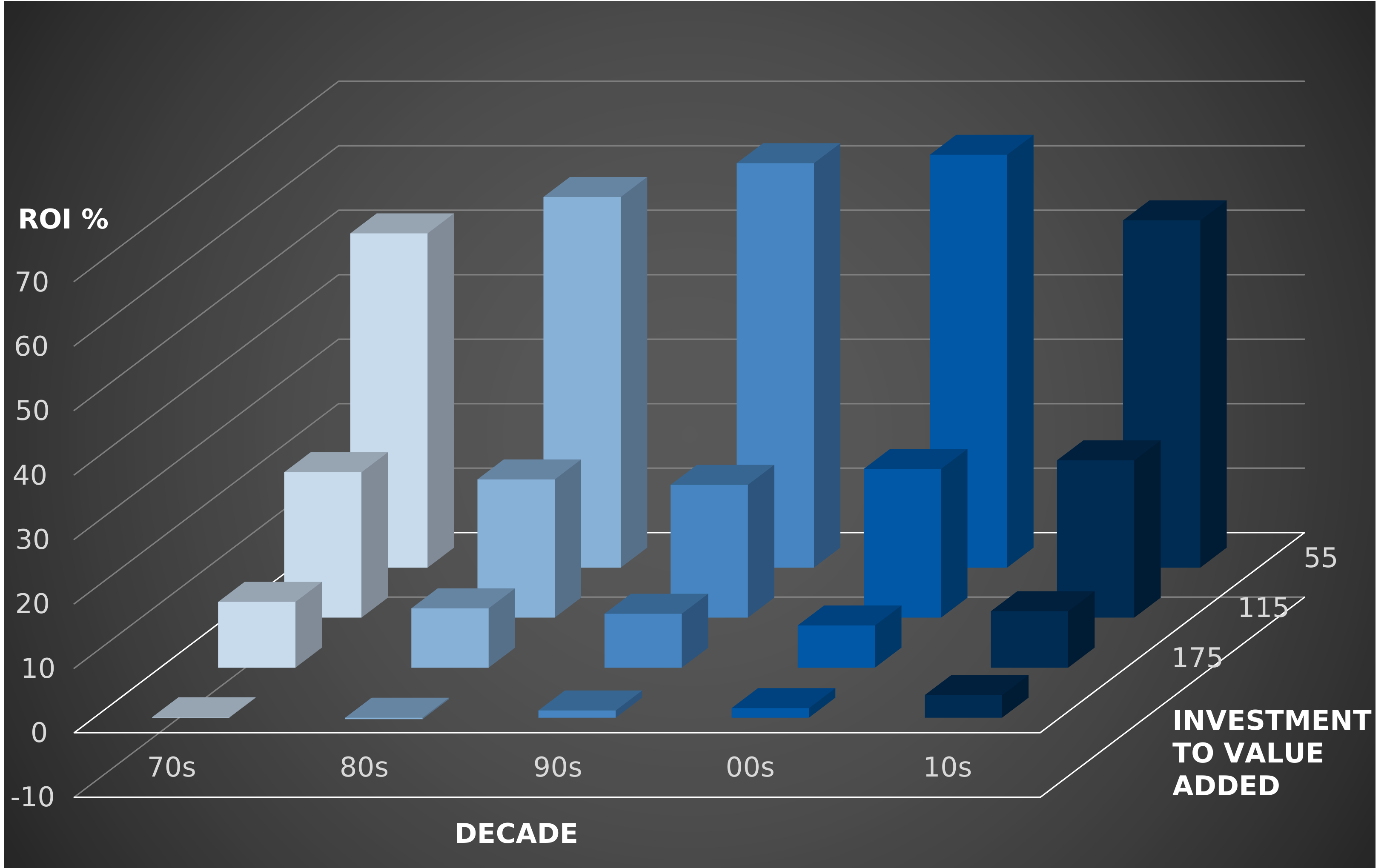
However, there is a school of thought that book investment is no longer a good measure of the resources deployed by the business, ignoring intangibles such as brand value, intellectual property, and platform strength, so there may be an element of a pure algebra – ROI is higher because you are dividing by a lower denominator. So to make things simpler, we will focus in the remainder of this article on ROS (EBIT as % of sales revenue). The ROI impacts tend to be stronger, because many factors with a positive impact on ROS (e.g. economies of scale, faster cycle times) have a negative impact on investment intensity.
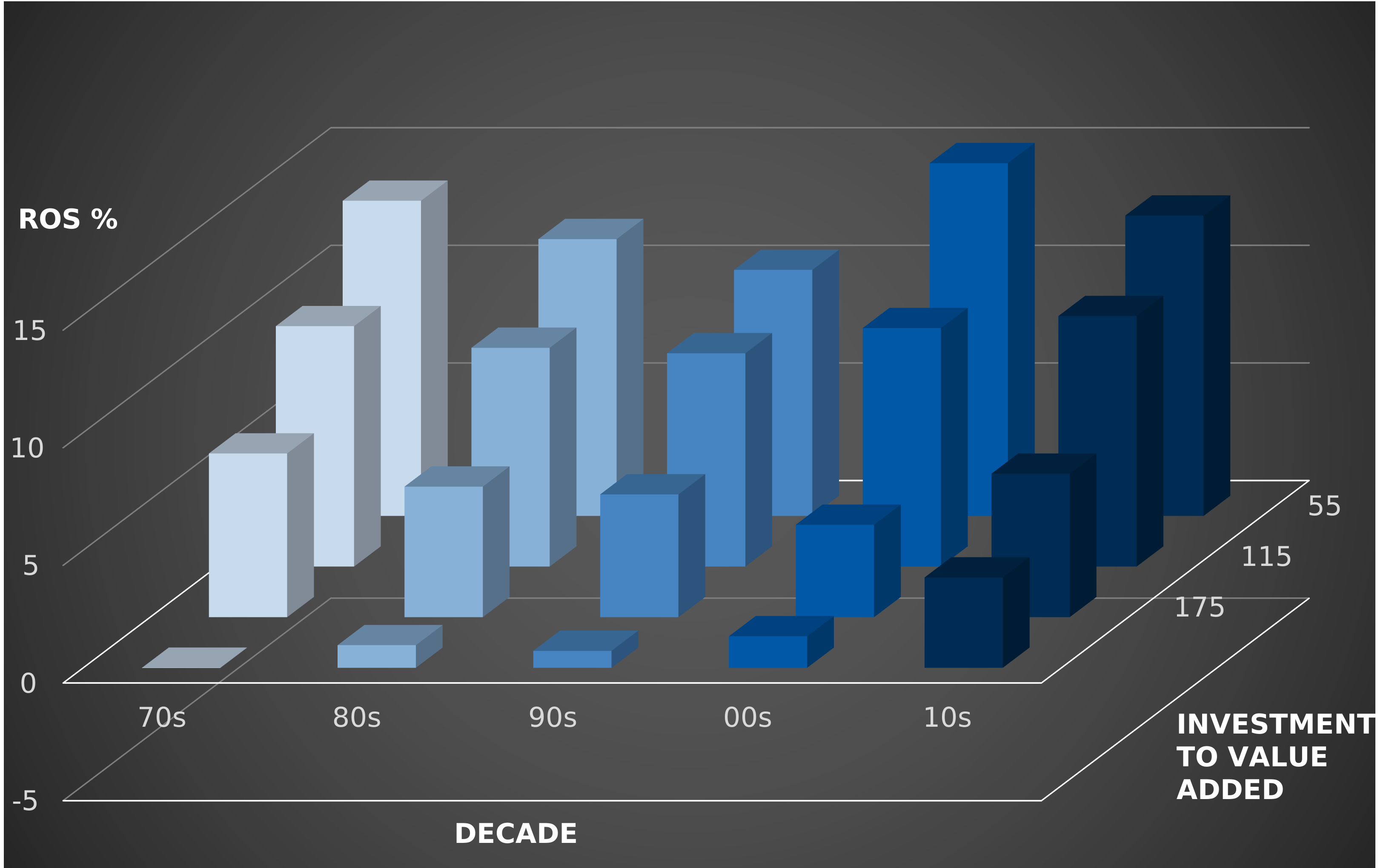
It is evident that the front row is still the lowest and the back row generally the highest. This flatly contradicts standard economic theory that firms invest to make higher margins! But it always has and still does. Please note that ROS can be affected by all sorts of other factors that are not equally distributed across bars, so there will be some unexplainable ups and downs.
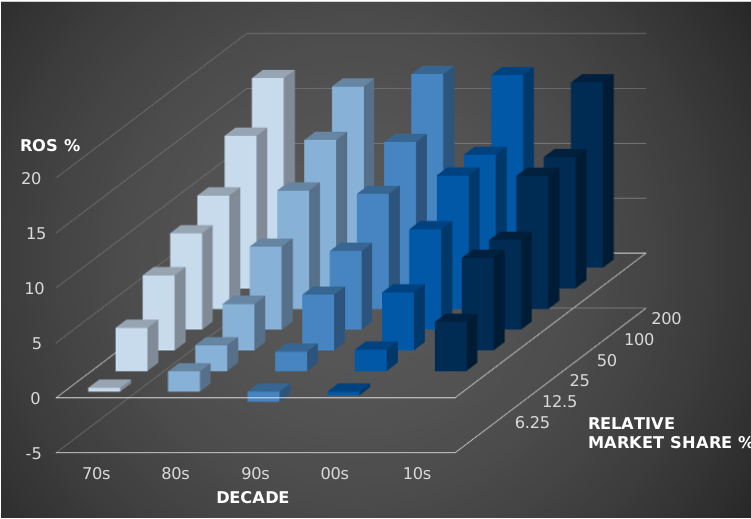
The second main profit driver is relative market share (your share divided by the three largest competitors: this is a stronger factor than either share relative to the single largest competitor or just absolute market share on its own). To get a full view we’ve sorted each decade into seven bars where the extreme bars have relatively few observations. Two things stand out: first, the effect is primarily time-independent, especially in the main range of 12.5% to 200% relative market share, where the slope remains similar. Something may be occurring at the extremes in the current century: very dominant businesses seem to enjoy a higher advantage, and very small players are scarce (perhaps the PIMS message is getting through and they are re-focusing on a niche where they have a decent share). Further confirmation will be needed in the 2020s.
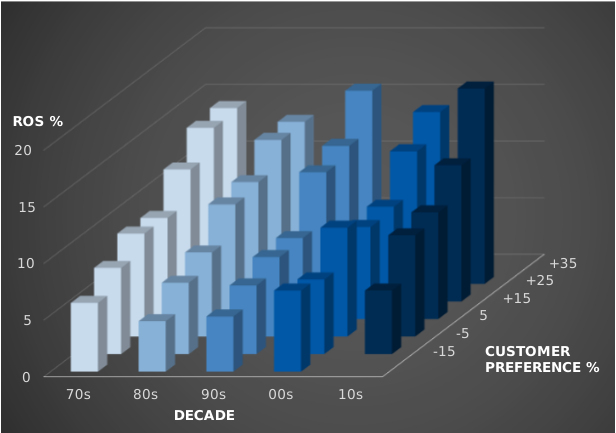
The third main profit driver is what we originally called relative quality, which we measure by looking at all the non-price attributes (product, service, image) affecting customer choice and weighting where you are superior against where you are inferior. Due to confusion with TQM and quality control metrics we’ve renamed it “Customer preference”. There is some noise in the data, particularly in the 2000s (where some average businesses do quite well), but the first-order effect is the same across decades: quality pays. As with share, we have no observations offering very inferior quality in the 2010s: perhaps again the PIMS message is getting through, at least to our clients! Also, we have the profit spike for very strongly competitive businesses.
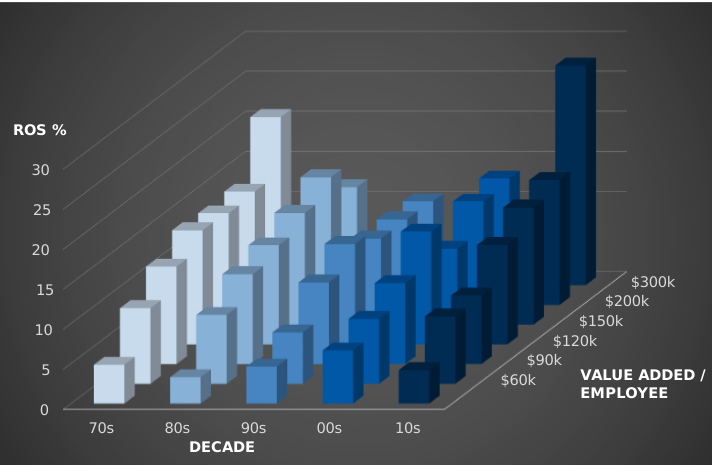
Factor four relates back to supply chain fitness: the value added per employee. This is measured in constant 2000 US dollars, and adjusted for high or low levels of profitability to avoid tautology. Again, there are a few wobbles, but high productivity generally pays and low productivity costs. The pattern for the 2010s is familiar, aside from a significant spike at the higher extreme driven by an outlier within the small subset of businesses at this level of labour productivity.
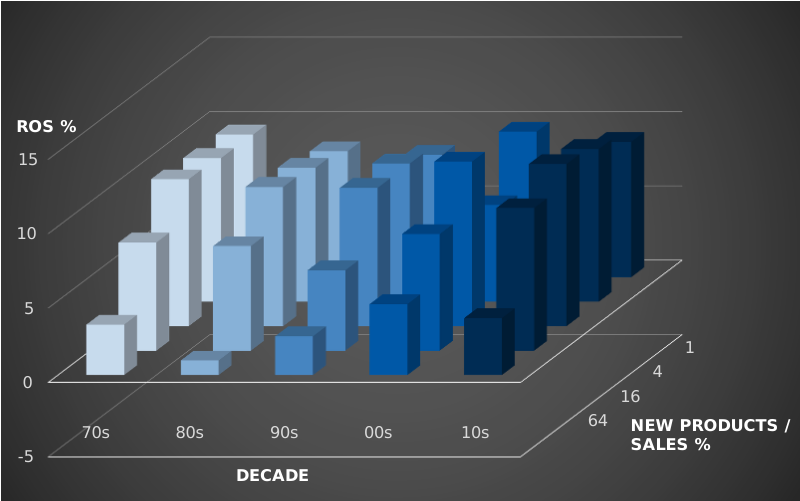
We measure innovation by the percentage of sales coming from step-change products launched in the previous three years. Line extensions (different sizes, colours, flavours, pack types etc.) don’t count. This historic message from PIMS has been that a middling level of innovation is best: and indeed on the chart the peak in each decade is between 4% and 16% new products. Very high innovation (>64% on the chart) tends to be expensive. In this century, the few observations with >64% new products appear to have slightly better ROS than in previous decades. Perhaps this is an indication that in a more software-driven century, innovation can be less burdensome. Certainly, in the post-pandemic world, so much has changed that innovation is essential.
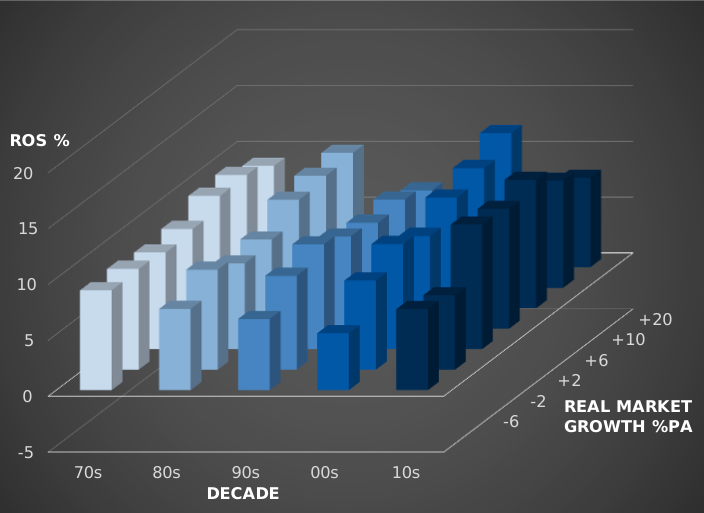
To many people, the most surprising PIMS finding has been how weak a profit driver is real market growth (i.e. correcting for inflation). Looking across the decades, the impact appears to be weak in the 1970s, increase a bit in the 1980s, wobble around for in the 1990s, then strengthen again in the 2000s, only to weaken again in the 2010s. The message is however the same: it’s better to be in a growing market, but it’s not as important as competitive strength or supply chain fitness.
The laws of business success have changed less than the pundits would have us believe. Any business can still learn from winning versus losing look-alikes (businesses that have faced similar positions in similarly attractive markets and similar labour and capital intensity) and derive benchmarks for costs, productivity, innovation, growth and profitability.
