





Talk to an expert


Economy and society are shifting from an old world, we know, to a new one, we don't know yet. Driven by five forces, including AI and systemic complexity, the GreatTransformation21® demands a fundamentally different approach to management.


What looks like a series of crises – demographic change, the growing complexity of knowledge and technology, environmental limits, rising indebtedness, and increasing systemic complexity – is, on closer inspection, something far more profound. Economy and society are in the midst of the GreatTransformation21®: a paradigm shift from an old world, we know, to a new one, we don’t know yet.
The term was coined by Fredmund Malik in 1997. It describes not a single disruption, but a generalised, fundamental transformation process for the 21st century, characterised by exponentially growing complexity, the emergence of globally networked systems, and dynamics of self-accelerating change.
Transformations of this magnitude have occurred throughout history, roughly every 200 to 250 years. The emergence of the Gothic period and the first universities in the 13th century. The era of the printing press and Reformation between 1455 and 1517. The Enlightenment and industrialisation from the mid-18th century onward. Each of these changed the world so fundamentally that those born afterward could barely conceive of what had come before.
The GreatTransformation21® is the next in that sequence. But it differs from its predecessors in three critical ways: its global scale, the degree of systemic interconnectedness, and the speed at which change accelerates. Previous superlatives such as megachange or disruption are already insufficient to describe it.
The term “Great Transformation” is not new. Karl Polanyi used it in 1944 to describe the rise of the market economy and the nation-state. Peter Drucker invoked “transformation” in 1993 to map the shift from capitalism to the knowledge society. Malik’s use of the term completes and generalises these earlier framings into something broader: a total transformation of how economy and society function in the 21st century.
The GreatTransformation21® is not driven by a single force. Fredmund Malik identified five complex, interacting drivers:
These drivers do not operate in isolation. They intensify each other. The result is a world in which malfunctioning – in politics, institutions, organisations – is becoming the new normal. Not because organisations are poorly led, but because they are navigating with tools designed for a different world.
The old world was governed primarily by the laws of money and economics. The new world is governed by the laws of information, knowledge, perception, and the dynamics of highly networked systems.
This distinction matters practically. Organisations that interpret the GreatTransformation21® through old-world categories (i.e. market cycles, financial indicators, traditional strategy frameworks) will consistently misread what is happening and why. What appears as an economic crisis is, at its core, a crisis of functioning: of management systems, organisational structures, and governance models that were not built for the complexity now confronting them.
The years since have only sharpened this diagnosis. The rapid rise of artificial intelligence is restructuring entire industries and labour markets faster than most governance systems can process. Geopolitical fragmentation – the unravelling of supply chains, the return of industrial policy, the fracturing of what once looked like a stable global order – adds a further layer of systemic unpredictability that no single financial model can capture. Malik identified these forces as structural, not cyclical, long before they became headlines.
The GreatTransformation21® poses new challenges that cannot be met with accustomed means. Past experiences no longer provide a reliable basis for understanding the impact of decisions; uncertainty reigns about tomorrow.
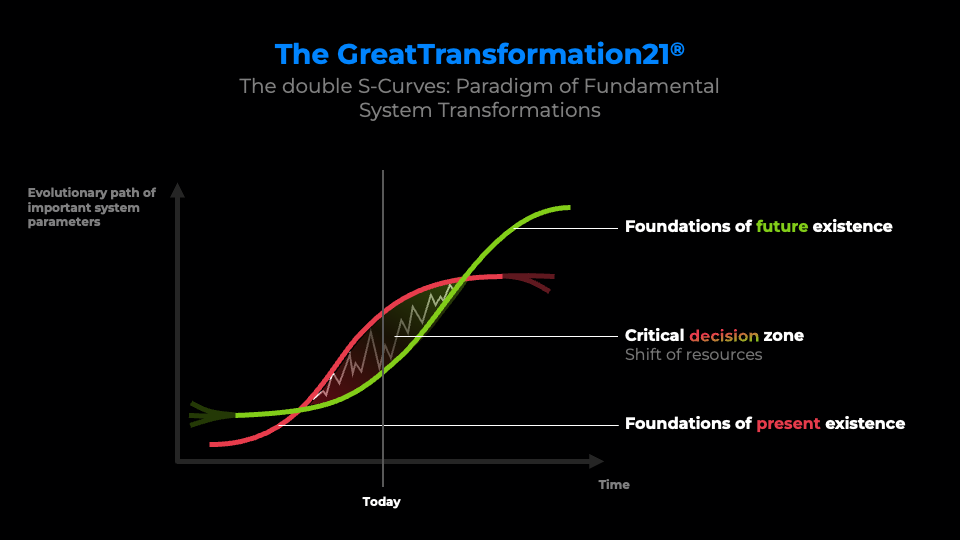
The icon of the GreatTransformation21® is the double S-curve (see below). It depicts the transition from the old world (the declining red curve) to the new world (the rising green curve). Not as a linear progression, but as an overlap: a period in which the old is still present while the new is already emerging.
Organisations currently live in this overlap. The challenge is not to manage one S-curve, but to navigate the crossing between two: to stay viable on the old curve long enough to build the capabilities required on the new one.
A transformation of this order does not call for incremental improvement. It calls for a fundamentally different approach to management, organisation, and governance.
At pims.ai | malik, this is precisely what we were built for. Our response to the GreatTransformation21® rests on two pillars:
Predictive Analytics: drawing on over six decades of PIMS® research and data from more than 4,300 businesses, we give organisations the evidence base to understand their strategic position and make decisions grounded in what actually drives performance, not in outdated assumptions.
Organisational Transformation: through Malik Management Systems®, rooted in the St Gallen systemic management tradition and management cybernetics, we equip organisations with the structural and leadership capabilities to function effectively under conditions of growing complexity.
The connecting principle is what cybernetics calls Ashby’s Law of Requisite Variety: only variety can absorb variety. As complexity grows, the management system must grow with it – in sophistication, in adaptability, in its capacity to self-regulate.
The GreatTransformation21® is not a problem to be solved and set aside. It is the permanent condition of management in the 21st century. Organisations that recognise this and invest in the right systems, frameworks, and capabilities, will not merely survive the transition. They will use it.
The question is not whether transformation is coming. It already has. The question is whether your organisation has the tools to navigate it.
pims.ai | malik helps organisations navigate the complexity of the GreatTransformation21® – through evidence-based decisions and effective organisational transformation.
